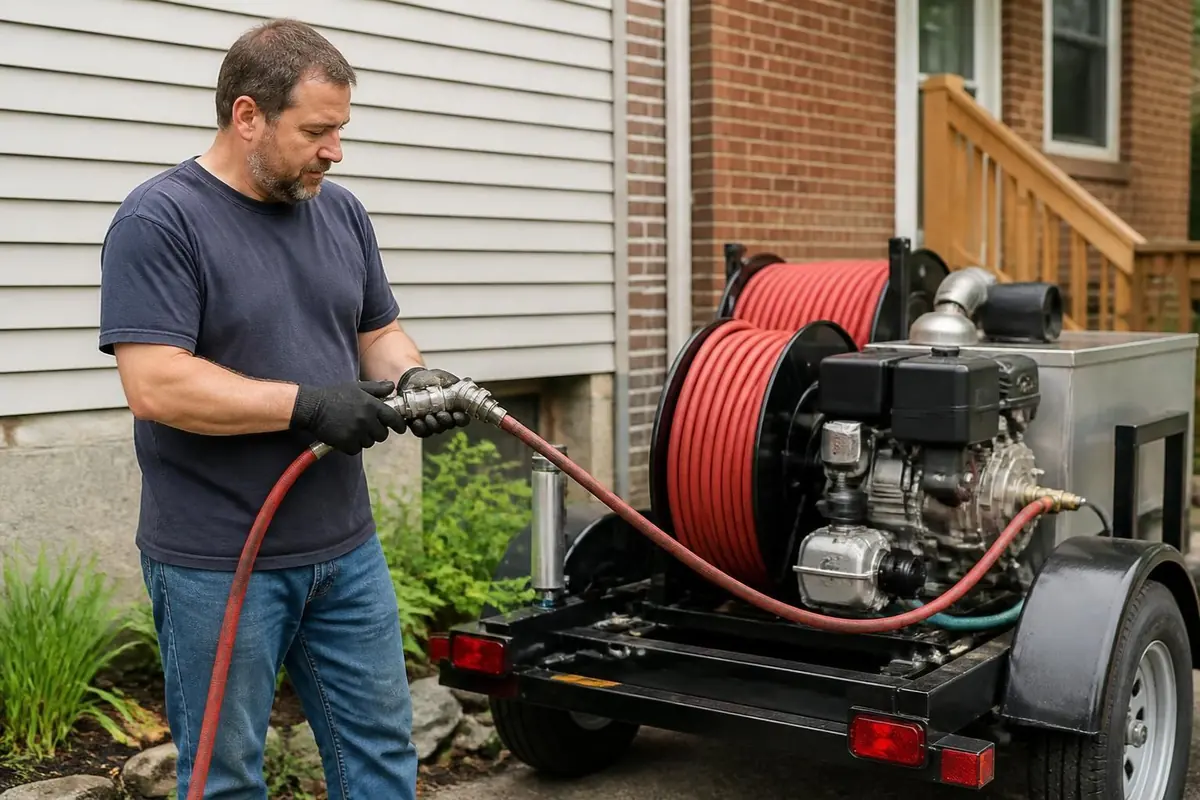
Hydro jetting in Lexington means running a high-pressure water nozzle through a drain or sewer lateral to cut roots and flush out the scale and grease that build up in older pipe. About two-thirds of the city's homes predate 1980, so the job often starts with a camera to make sure the pipe can take it. Call the number on this page to be connected with a local plumber in Lexington.
Lexington's housing and sewer lines
Few towns around Winston-Salem have housing as old as Lexington's. Census survey figures put the median home at 1969, with about 68% built before 1980 and around 14% before 1940. That includes the Uptown Lexington and Lexington Residential historic districts and the Erlanger Mill Village, where houses were built when clay tile and cast iron were the standard for sewer pipe.
The City of Lexington runs its own sewer system along with water, electric and gas, and treats wastewater at its plant on Glendale Road. Trouble in the public main is the city's to deal with. The lateral from your house to that main is usually where a homeowner's backup starts, and in an older house it is often the pipe material itself that sets up the clog: roots slip through clay joints, and cast iron grows a rough, scaly lining that snags paper.
Three ways to deal with a stubborn line
| Approach | What it does | Best fit |
|---|---|---|
| Cable machine (snake) | Bores a path through the clog with a rotating head | A one-time blockage in sound pipe |
| Hydro jetting | Scrubs the full pipe wall with high-pressure water, cutting roots and scale | Lines that keep clogging from roots, grease or buildup, if the pipe is intact |
| Spot repair or replacement | Fixes or replaces a cracked, sagging or separated section | Pipe the camera shows is broken, collapsed or badly offset |
In a 1950s or 1960s Lexington house, the camera usually decides which row applies. Jetting a line with a collapsed section only buys time.
Signs it's time to call
- Basement or lowest-floor drains taking on water when upstairs fixtures run
- Toilets that gurgle or rise slowly before draining
- A cable that comes back with root hair or rust flakes
- Repeat clogs on the same line within a few months
- Soft or sunken ground over the path of the sewer pipe
Timing and seasons
Roots grow most actively in the warm months, so root-prone clay laterals often act up from late spring through fall. Kitchen lines tend to struggle after holiday cooking, when more grease goes down the sink. If your line has a known root problem, scheduling jetting before the growing season starts can keep it ahead of trouble. A backup that is already sending sewage into the house shouldn't wait for a convenient day.
Hydro Jetting questions in Lexington
Is high-pressure jetting safe for an old clay or cast iron sewer pipe?
Will tree roots grow back after a line is jetted?
Sewage is coming up in the house. Do I call the sewer utility or a plumber first?
How often does a main drain line need jetting?
More plumbing services in Lexington
Hydro Jetting nearby
Helpful guides
Sources
Last updated: